Hana – Figure Study with Chair
Ilford Delta 100, scan of 4×5 negative
model: Hana Rose
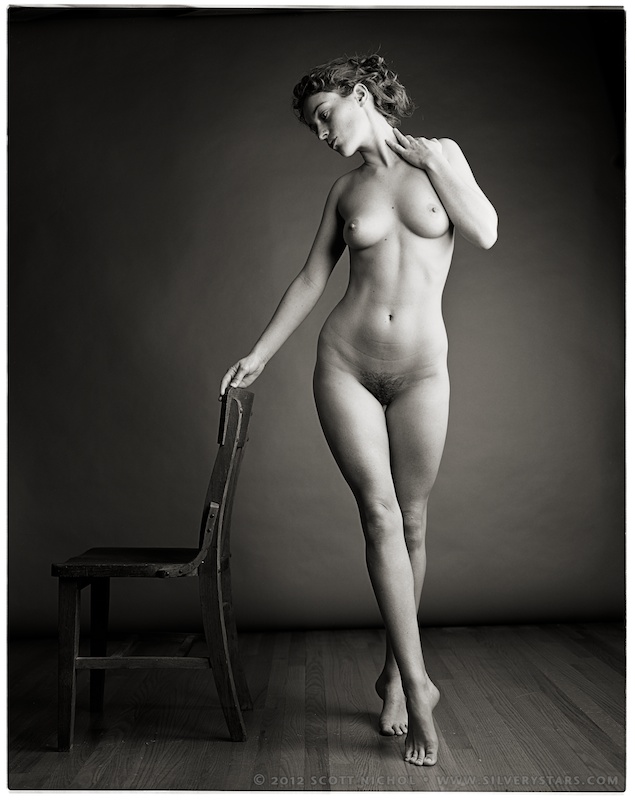
Photography by Scott Nichol
Hana – Figure Study with Chair
Ilford Delta 100, scan of 4×5 negative
model: Hana Rose
a wonderful, lazy snow day. i’d planned to shoot with Hana and we just kinda went about things slowly, with no real hurried pace. the kind of shoot i really like. 50 digital snaps (including test shots) and a bunch of film frames. done.
model: hana rose

This is a headline I would truly love to see come across the Mac New blogosphere someday soon. I am committed to Apple’s products from a hardware and software perspective. It’s a choice I make, mostly because I like the way their products work. Am i an Apple fanboy? Yeah, a bit. But this decision is also based on having to work with a develop software for Windows PCs every day. I’m often frustrated with the choices made by those who develop software for the Windows platform as well as the carelessness with which Microsoft creates the platform. I know this isn’t pretty picture of women, but I have a vision that I would like to share. So, allow me a momentary divergence.
In 1999 Apple bought some technology from macromedia called Final Cut Pro. It was non-linear video editing software that ran on desktop PCs. After apple bought it, they developed it into a mature product, added important features like support for Firewire import from both consumer and profession digital video cameras. Final Cut Pro was $1000 and was hands-down the cheapest way for independent film producers to edit their projects. Adoption at the professional level took off quickly and when version 3 was released around 2003, Walter Murch used FCP to edit Cold Mountain. He was subsequently nominated for an academy award for his editing work on that movie.
FCP quickly became the platform of choice for many independent and professional video editors. It was clearly a professional product and the requirements from its user base were very, very demanding. The complexity of producing motion pictures today varies as widely as the subject matter. An interestingly, with the latest release of FCP Apple has decided to take away some of the features that professionals rely on most. Even though the application is moving forward in terms of support for features like real time effects, a modernized architecture, and a tapeless workflow, the fact is that these features don’t serve the professional community very well. I’m not sure if it’s just short sighted of Apple to disregard the needs of professionals who have come to rely on this platform or if they really just don’t care? But I’m not terribly vested in FCP. I have version 5 (or maybe it’s 4). It almost still works when I need it to, but mostly I can get by creating my photo slideshows with Motion. For a while I thought I might be more of a filmmaker, but now I know I’m not.
But I am heavily vested in Aperture. I’ve got more than 50,000 images in my Aperture library. For the most part it handles them all with aplomb. It’s a real workhorse. It handles organization of my images really well, giving me tools that make sense. It has automated backup, excellent image adjustment tools, and many of them can be easily masked for selective adjustments. Is there room for improvement? Always. But the last time a major new version of Aperture was released was in February of 2010, almost 2 years ago. Even though the software works well, I’m not sure if I’m just off in the wilderness alone sometimes. And I know I’m not the only one who thinks this way. Most serious photographers that I know are using or switching to Adobe Lightroom. It’s got support from a software developer that’s completely focused on imaging software. And that’s a comfortable place to be with 50,000 images.
But I still like the software that I’ve chosen. I’ve downloaded the trials of Lightroom and found, in general, that I didn’t care for it much. Maybe i needed to give it more time, but honestly, I don’t feel like I should have to. There’s a perfectly good solution here that has all of the features I want in a comfortable, trusted environment. And I truly believe that there’s a solid team of software engineers that have brought Aperture to life and have some amazing things they would like to do with it. But it seems like we never get any insight into the future path of the Pro Apps at Apple until after they’re released. And then we just get to complain, seemingly to deaf ears, about all the things we don’t like. Just ask the FCP crowd, I’m sure they’ll give you an ear full.
I love photography and there’s not a day that goes by that I’m not using Aperture and Photoshop. In order to maintain my passion for my art, I need a serious set of tools. I also need to know that the company behind them has a dedicated roadmap of continued development so that my investment in this software continues to bear fruit.
So, I’ll say it now that my fervent wish is that Apple takes its Pro Applications division which includes Final Cut Pro, Aperture, and of course Logic and spins them off into their own entity. Make it a subsidiary of Apple, Inc like they did with Filemaker. It’s clear that Apple’s primary focus is not on application software development. Their focus is increasingly on platform development and the delivery of content for those platforms. A move like this would spark quick and fevered innovation within each of the software application platforms. Customers would benefit and the market share for each application would most likely accelerate. With each of these applications, I could image a great deal of improvements.
Final Cut Pro
Thrown to the wolves without the deep Apple coffers to back prop it up, it would have to fight for survival. The rich feature set that made it the Non-linear Editor of choice in the past would need to be quickly ported to the new application and an updated release would be available within 3 months. (You have to consider that some of this work is already being done as a result of the backlash from the missing features in FCPX.) Future versions would add advanced features not available in Avid and Premier Pro. The FCP team would work closely with RED to provide unrivaled support for editing RED’s RAW format.
Aperture
Support for RAW formats for new cameras will appear within days or weeks of a new camera’s release. And beyond that, this new company will align with Adobe in encouraging all camera manufacturers to embrace a universal RAW data format. Call it DNG if you want, but a set of metadata within the RAW files will allow any software to interpret and read the image data without software updates. Within a year, all camera manufacturers will embrace this going forward. Aperture will implement support for importing directly from digital film scanners. This has been a pet peeve of mine for some time and in previous versions of Aperture, my film scanner actually showed up in the import pane.
Aperture’s book design engine will allow for export to the most popular print on demand services like blurb.com and lulu.com. Additionally, a tool will be created that allows printers to quickly and easily create a plugin with the specifications for designing books and high end wedding albums right within the application. The plugin will also allow a complete photo book to be designed, uploaded, and ordered right within the application. Also, after a simple registration process, photographers will be able to upload their book designs to the Apple iBookstore and offer their books for sale as eBooks.
The team will create an external editor. At first it will allow for simple pixel level operations like retouching with clone and healing brushes. It will have features like curves, levels, and a host of other adjustments that can be stacked and masked. It will work quickly and with a fluidity that’s not currently seen in the maskable adjustments within the Aperture application. Will it work like a little Photoshop-lite? You betcha. And for quick edits, this will be quicker and easier to use than Photoshop. This is also when you’ll be able to set up multiple external editors within Aperture. So I can quickly choose if I want to send an image to Photoshop, the built-in image editor, or something else entirely like Snapseed or Pixelmator.
Similarly, working with fulfillment services will be tightly integrated within the application. Uploading images will no longer require a fulfillment service to create an export plugin, the tool will be provided by the Aperture team and it will generate an export preset that requires no coding on the part of the fulfillment service.
The number of adjustment presets included with the application will double or even triple. The selection will rival that which is included with packages from plugin makers like Nik Software.
Web gallery support will be robust and HTML-5 based. The code generated will be standards-compliant and compact. It will be easy for photographers to develop beautiful animated slideshows of their work. The slideshows can be easily exported and integrated into their own web sites or popular blogging platforms like WordPress. The Aperture application will included hooks to install the necessary plugins into your WordPress blog and after some setup on the WordPress admin side, Aperture will be able to feed content directly to your photo blog. In addition to Facebook and Flickr, export options will be available for other content web sites like Twitter, Tumblr, and other popular platforms.
Is all this within the realm of possibilities? I certainly think so. But as long as the pro applications are part of Apple, these kinds of radical and innovative features don’t bear to see the light of day. Apple’s primary focus right now remains with brokering content deals for iTunes (music, movies, and TV), the iBookstore, and Newsstand. The revenues generated from their commission on selling this content most likely dwarfs the revenue form Pro Apps. With the Pro Apps freed from Apple, you’ll see versions ported to Windows and the diversity of software choices will flourish all around. And when it comes to software like this, I don’t think that Adobe needs to be the only game in town. The only viable software portfolio to challenge this competition is sitting with the walls of 1 Infinite Loop. Those apps are ready to leave the nest a become responsible, adult citizens in the creative software community.
i’ve been wanting to shoot with Cam Damage since sometime this summer when i saw her work with Chip Wills. and now that i’ve gotten settled again back in my home studio i decided to try working a bit with her here. it takes me back to my origins, really. the time before i rented a studio space. the old familiar wooden floor boards in my own home. it’s nice, comfortable. it makes other parts of my house more crowded for the furniture i’ve moved out of the way, but nobody else is here to complain.
model: cam damage

i don’t often work in color, but i recently had the chance to shoot with a model named Porcelain and thought it was a good time to shoot some of the Provia slide film i was given by the Fuji rep at Photo Plus Expo. the sun was setting fast and we had some of that golden light streaming into the room.
scanned, cropped, and color-tweaked in photoshop.

holiday time usually means some down time from the day job which means that i’ve got plenty of time to work on personal projects. so, i’ve been spending quite a bit of time reviewing photos from my archives. and today i came across this photo from December 2008 which i’d marked with 5 stars (out of 5). so, when i shot it, i thought it was really good. worthy of being edited and turned into a piece of artwork. finally, today, more than 3 years later i finally got back to it. and it just feels really wonderfully classical in both pose and lighting. i think i might return to this style and composition, especially with the 4×5 camera.
enjoy,
scott

i’ve finally got some of the e-commerce features of the site up and working and now have the ability to offer some of my wonderful alternative process prints for sale. they’re a bit more affordable here than they would be when selling through a gallery since i don’t have to work in the gallery commission fees. these prints are made using traditional, 100-year-old darkroom processes and are some of the most beautiful prints i’ve ever made.
so, if you manage to find something in your stocking that might help to support the arts, take your pick. in most cases, there are only one or two prints of each of these images.

i was asked recently if i only ever work with thin women. this seems to be a topic that comes up from time to time, not only for me but other photographer friends of mine. the answer is, of course, no. but the majority of the women i work with are very fit and trim. i think this has more to do with the fact that the majority of the models i work with tend to have rather delicate figures. but i recently had a chance to work with a woman who was more well-rounded, shall we say. and she breathtakingly beautiful. ultimately, for me it matters not what your body shape is, but rather the way you communicate with the camera and the connection you project to the viewer.
what are your thoughts, my dear blog readers? leave a comment and tell me if you have any kind of body shape preference? does it matter if the model is thinner or rounder? what really gives the photograph artistic merit? share your thoughts in the comments.
model: Diana Di Bella



Summer 2007 at Beach Island State Park in New Jersey with model Hillary Marie. This is a new photo that I discovered while editing content for this copy of the book. I really loved its contrast with the other photo from that day.
This photo is part of the book in the still air, available for purchase now at blurb.com.

| Standard 8×10 Photo Book eBook Format for iPad/iPhone |
Available for purchase now from blurb.com
| Standard 8×10 Photo Book eBook Format for iPad/iPhone |


 So Many Stars