Photo Mobility

So, I am writing this posting from a bus traveling from New York City back home to Allentown. It’s becoming quite apparent to me that we’re living in a world that is becoming simultaneously more interconnected and more mobile at the same time. The bus I’m riding on has WiFi and I’m connected to my blog through the WordPress app on my iPad. I’m listening to Pat Metheny in the background and watching the high clouds intensify as we travel west.

Before I left yesterday, I finished up a morning shoot with a model named Firefly Sky and I quickly transferred some of the shots to the iPad so i could review them on the trip up. And I actually brought one of the shots into an app called Filterstorm and produced a really nice, clean edit of the shot. Sure, it’s just a black and white conversion, but I was able to use a curves adjustment tool to recover the highlights a bit and use the channel mixer on the black and white tool to get the skin tones looking really nice.

Is this a bit of gadget geekery? Of course it is, but it’s also kind of liberating. The experience is light and effortless where a laptop would just be cumbersome. The freedom to create while you’ve got the downtime of a bus ride is exciting in ways that are, dare I say, magical and revolutionary.

See you all when I get home…
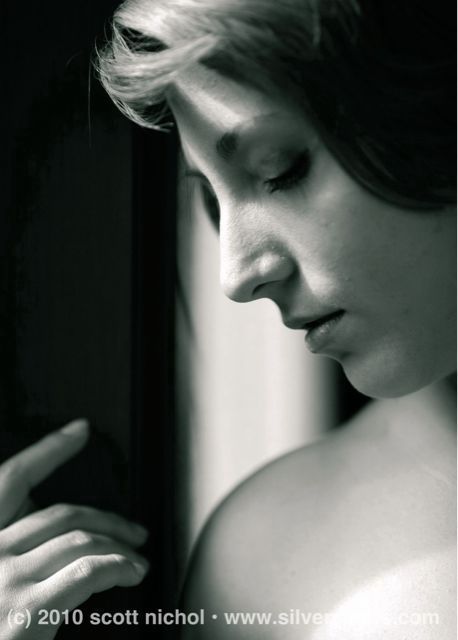
Firefly - iPad Portrait
Lili Adonia - iPad Portrait

salted paper prints

well after about a full day of curve design and some tweaks this morning, i finally got a curve that produces a fairly linear curve for salted paper prints.  the salted paper process was invented by William Henry Fox Talbot, known as The Father of Modern Photography, in 1833 while he was on his honey moon.  the kit that i am using from bostick and sullivan uses a solution of Ammonium Chloride and Sodium Citrate as the salt sensitizing agent.  a Silver Nitrate solution gives you the metal base to create the image.  the paper is coated with each solution and then exposed to UV light to create the image.  after the exposure is complete, there is no development per se.  the image is already formed on the paper.  you’re only left to wash away the unused silver and then the print is fixed in regular photo fixer (Sodium Thiosulfate).  the result is a print with blacks that are kind of dark chocolate, but toning the print in a gold chloride solution gives the prints a more neutral, almost eggplant tone that’s really pleasant.

this scan is of one of my first artist proof prints and the tones are about right.  its cropped not exactly how i want it, but rather to match the size of the coatings i’d done.  as i write this, i’m waiting for a few more 8×10 inch sheets to dry and i’ll make a one or two more prints tonight.  with a 20-minute exposure time, it take a while to make each print, but they’re quite worthwhile!

enjoy,
scott

Kiera - Beltzville, Frame 6.  5x7 inch Salt Print, toned with Gold Chloride
Kiera - Beltzville, Frame 6. 5x7 inch Salt Print, toned with Gold Chloride

film: Ilford Delta 400 at ISO 800
model: Keira Grant

rockin’ the low contrast

i recently revisited a few images from a session i did with a friend Olivia.  we spent an few minutes at a workshop i was teaching working with a very simple lighting setup.  a single, large softbox over head and close to the wall where Olivia was posing.  when i went to finish these images, i started to play with a much lower-contrast look than i’m normally accustomed.  and i was really thrilled with how well this look conveyed the emotions of her poses.

Olivia - Workshop Low Contrast #1
Olivia - Workshop Low Contrast #2
Olivia - Workshop Low Contrast #3

Palladium Prints

a little while ago i ventured back into the darkroom armed with some new ideas for tweaking my palladium printing techniques.  i wasn’t happy with the prints that i’d made before.  there were issues with clearing the prints and the density of the blacks wasn’t exactly where i wanted it to be.  i’d read on an APUG thread that, while the developer lasts almost indefinitely, it does need to be replenished and that a little bit of fresh potassium oxalate should be added before each printing session.  there were also recommendations for clearing baths – using disodium EDTA and adding some sodium sulfite to the tetrasodium EDTA.  so i ordered some new chemistry from Art Craft Chemicals and had another go at it.  right from the first couple of test prints it was obvious that the process was working much better than anything i’d done previously.

the following images are scans of the palladium prints made that weekend.  the enlarged negatives were made from scans of the original film frames, printed on Pictorico OHP transparency film with a custom Quadtone RIP profile.  the prints are about 9×11 inches, printed on 11×15 sheets of Arches Platine paper.  they are available for purchase.

Stephanie Anne - Clay Frame #2

btn_buynowCC_LG

Stephanie Anne - Clay, Frame #3

btn_buynowCC_LG

Stephanie Anee - Clay, Frame #5

btn_buynowCC_LG

my reflected self

Maria - Reflection at Ringing Rocks

the reflection in this shot is not photoshop trickery again.  this was a pool of still water that we found out at ringing rocks park.  the mirror like surface is just what came through the lens!

shot on Ilford Delta 400, pushed to ISO 800.  1/8th of a second at f/5.6 if i recall.  scanned from the negative.

a sunday morning

sunday morning with Desalle.  one image shot with the “Legendary” Canon 135mm L series lens, the other shot with my Lensbaby composer.  beautiful both ways, i’d say.

Desalle - Natural Light with the 135mm
Desalle - Lensbaby Composer (with soft-focus aperture)
Desalle - Lensababy Composer Double Glass Optic (with soft focus optic)

midday, june 2010

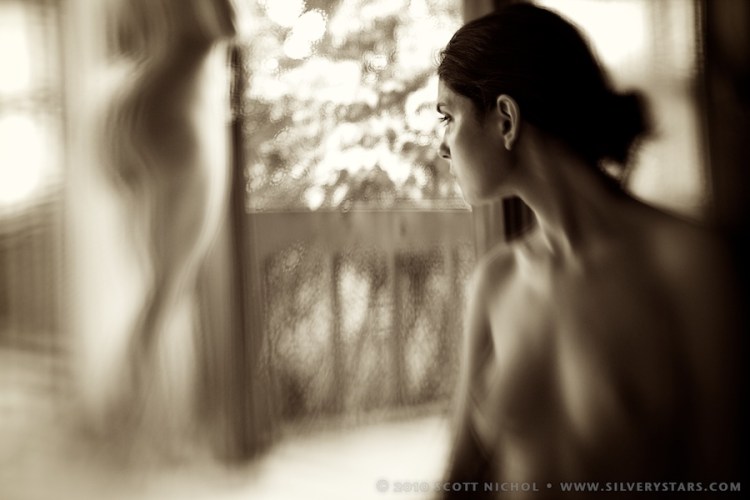
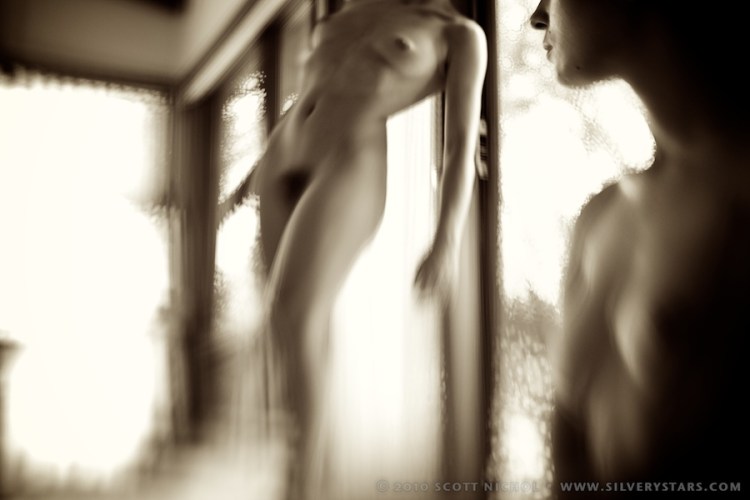
after having some of my work featured on the Lensbaby galleries, it kinda reminded me that there was an experiment i wanted to do.  Lensbaby makes a soft focus lens that has an interesting aperture ring.  its got a larger hole in the center, then smaller holes around the rest of the ring.  i assume that with the soft-focus optic this enhances the soft focus effect.  but i’ve been wondering what would happen if you put this aperture in one of their other optics, say the double-glass optic.

low and behold, magical things started to happen.  notice the out of focus highlights and the really cool rippling effects going on?  that’s all optical kids.  no photoshop skillz required.

models: Katlyn and Sweet Romance

enjoy.

my days with you
my days with you
flow lazy hot and languid